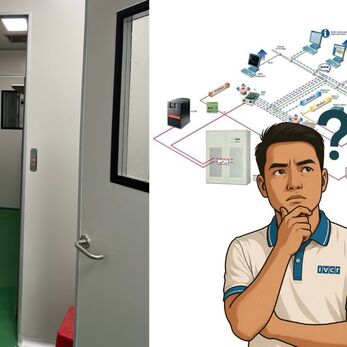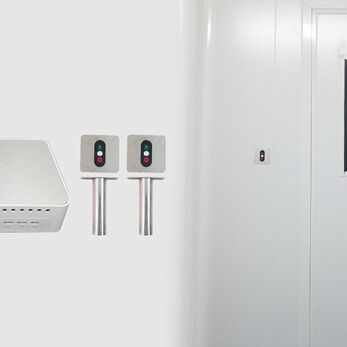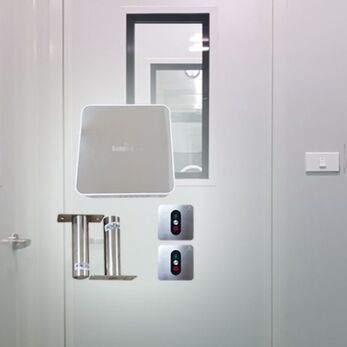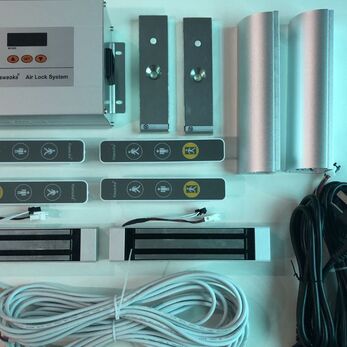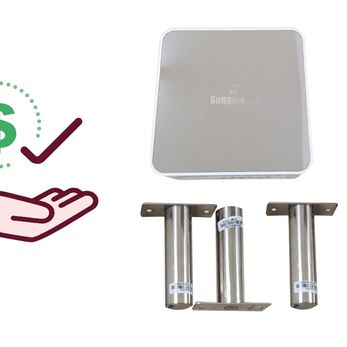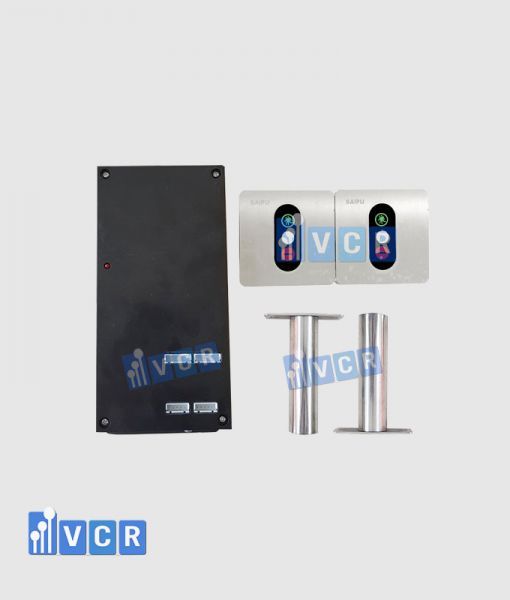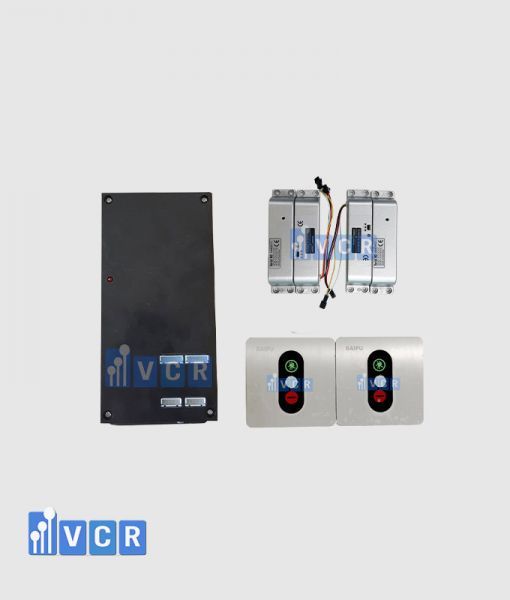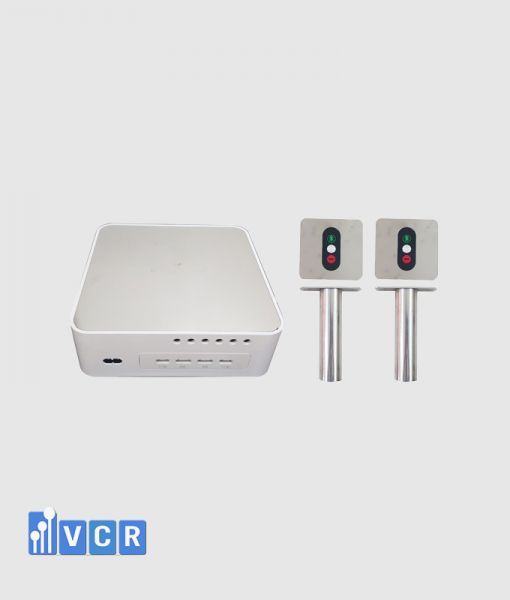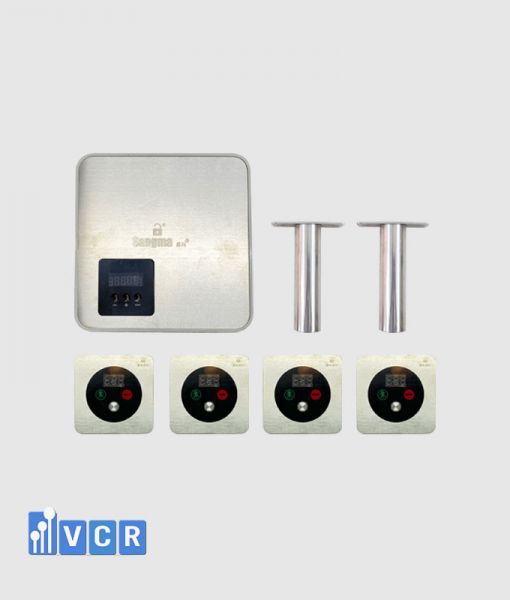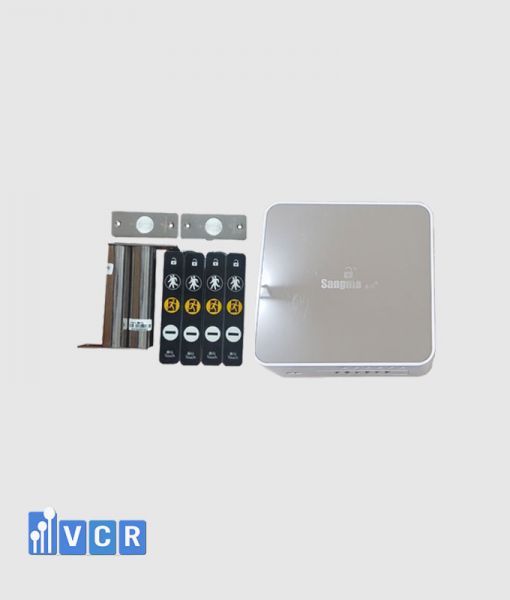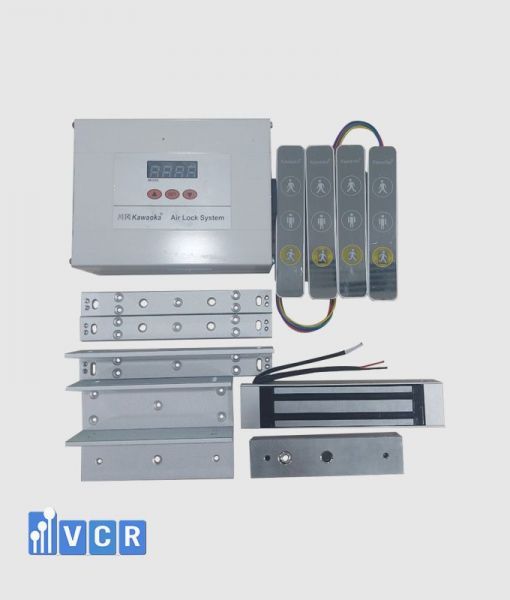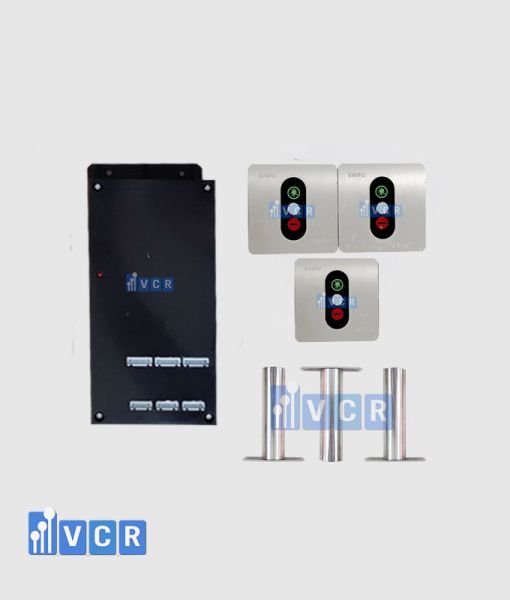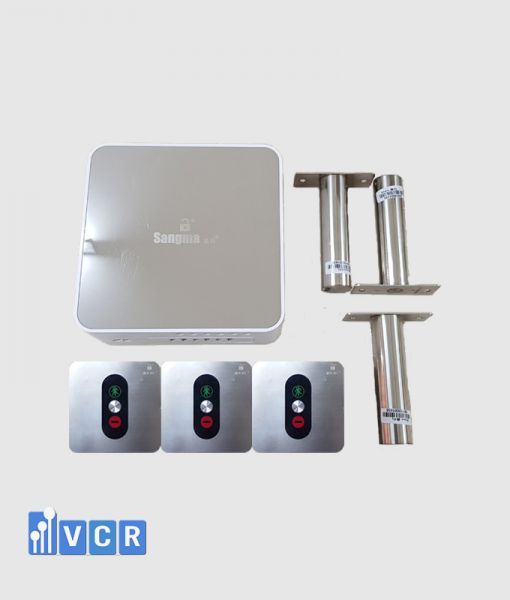

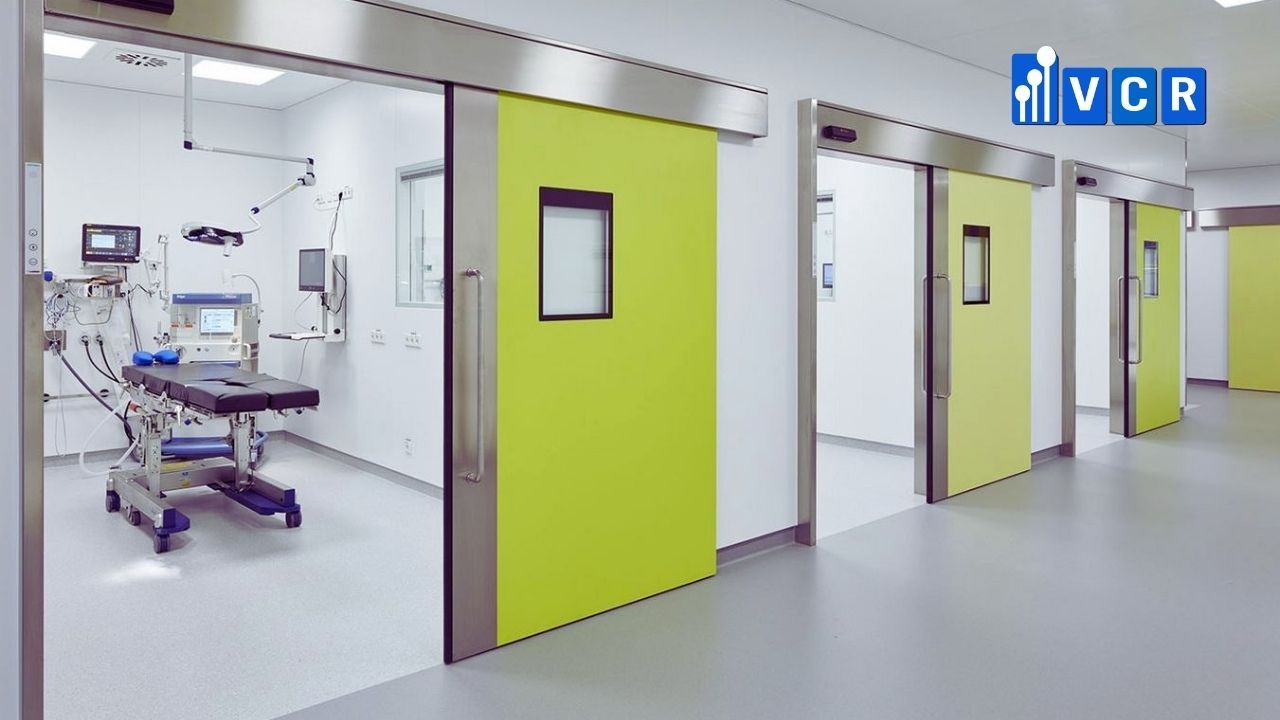
An interlock system can be integrated with automatic doors in cleanrooms, airlocks, buffer rooms, and contamination-controlled areas. The system prevents two doors from opening simultaneously, maintains pressure differentials, and improves operational safety.
- Can an interlock system be used with automatic doors?
- How does an automatic door interlock work?
- Why should automatic doors be integrated with an interlock system?
- What conditions must an automatic door meet for interlock integration?
- Components of an automatic door interlock system
- Is an electromagnetic lock required for an automatic door interlock?
- Automatic door interlock control methods
- Is an automatic door interlock suitable for cleanrooms?
- Important considerations when designing an automatic door interlock
- Can an interlock system control three or more automatic doors?
- Where should you buy an automatic door interlock system?
- Criteria for selecting an automatic door interlock supplier
- Conclusion
- FAQ: Frequently Asked Questions About Automatic Door Interlock Systems
- Does the interlock system directly control the automatic door motor?
- Can an automatic door with a motion sensor be integrated with an interlock system?
- Does an automatic door interlock require an electromagnetic lock?
- What happens to an automatic door interlock during a power failure?
- Can an interlock system be connected to a fire alarm system?
- Can an automatic door interlock be connected to a BMS?
- Can one interlock controller operate several automatic doors?
- What factors affect the price of an automatic door interlock system?
- Contact Vietnam Cleanroom Equipment
Can an interlock system be used with automatic doors?
Yes. An interlock system can be fully integrated with automatic doors, provided that the automatic door controller has suitable input and output signals for connection to a dedicated interlock controller, PLC, or central control system.
When one door is open or has not completely closed, the interlock system prevents the other door from receiving an opening command. The second door can operate only after the sensor confirms that the first door has fully closed.
This solution is widely used in pharmaceutical cleanrooms, hospitals, laboratories, electronics and semiconductor factories, food-processing facilities, and other areas requiring pressure differential or cross-contamination control.
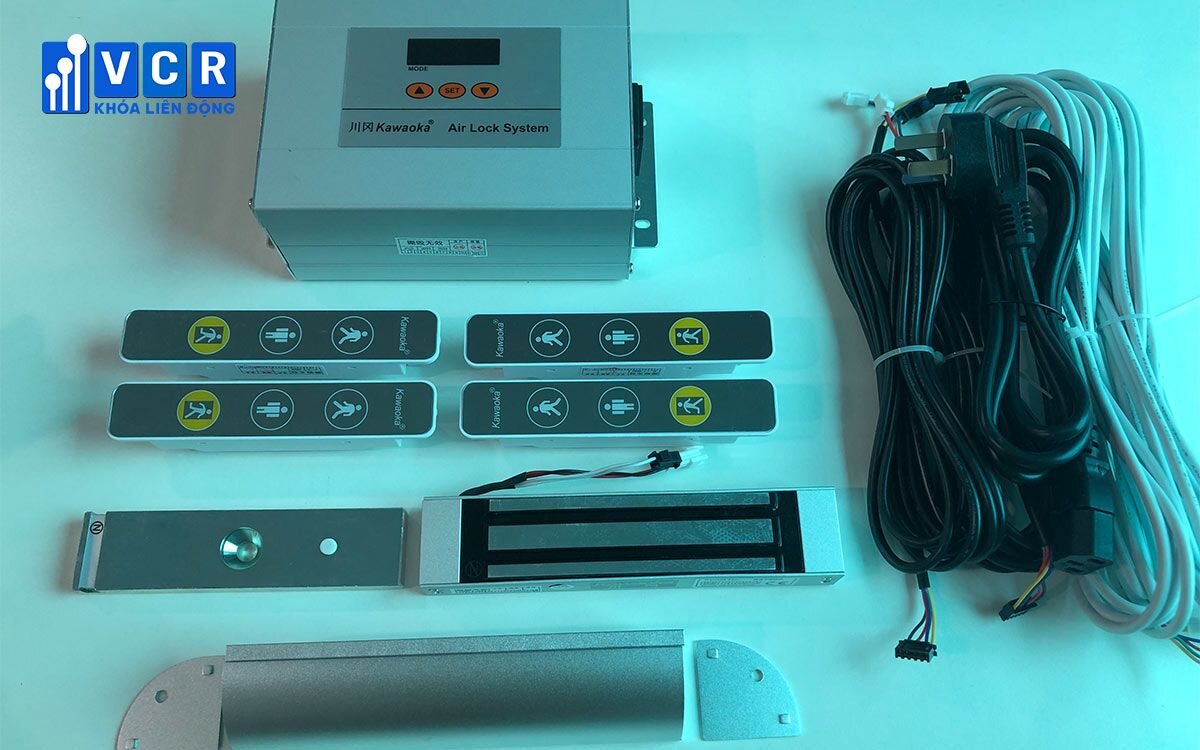
How does an automatic door interlock work?
In a two-door automatic interlock system, each door is normally connected to a door position sensor and an automatic door controller.
When Door A receives an opening command, the interlock controller temporarily disables the opening signal for Door B. While Door A remains open, users may press the opening button, present an access card, or activate the sensor at Door B, but Door B will not open.
After Door A closes completely and its sensor sends a closed-status confirmation to the controller, the system allows Door B to receive an opening command.
This operating principle prevents the two doors from opening simultaneously, reduces uncontrolled airflow, and helps maintain the required pressure differential between adjacent areas.
Why should automatic doors be integrated with an interlock system?
Automatic doors reduce hand contact, improve convenience, and support better control of personnel movement. However, when two automatic doors in the same airlock are not interlocked, they may open simultaneously when people approach from opposite directions.
This can cause a loss of pressure differential, disrupt the intended airflow direction, and increase the risk of particles, microorganisms, or other contaminants entering the cleaner area.
By integrating an interlock system, the doors operate in a controlled sequence. This reduces operating errors and helps maintain stable environmental conditions.
What conditions must an automatic door meet for interlock integration?
To integrate an interlock system, the automatic door controller should provide external control signal terminals. The basic signals normally include:
-
Door opening request signal.
-
Door opening permission signal.
-
Door open-status feedback.
-
Door fully closed confirmation signal.
-
Automatic door controller fault signal.
The system should not rely solely on the motor stop signal to confirm that the door has closed. The motor may have stopped even though the door leaf has not fully closed because of an obstruction, mechanical misalignment, or sensor failure.
For this reason, a separate sensor should be installed to confirm that the door has returned to its fully closed position.
Components of an automatic door interlock system
A typical interlock system for automatic doors may include:
-
Dedicated interlock controller or PLC.
-
Automatic door controller.
-
Door closed-position sensor.
-
Anti-pinch safety sensor.
-
Door opening push button or touchless sensor.
-
Access card reader, where access control is required.
-
Door status indicator lights.
-
Audible alarm or buzzer.
-
Emergency door release button.
-
Backup power supply, where required.
For larger systems, the interlock controller may also be connected to an HMI, BMS, fire alarm system, or centralized access control system.
Is an electromagnetic lock required for an automatic door interlock?
Not every automatic door interlock system requires an additional electromagnetic lock.
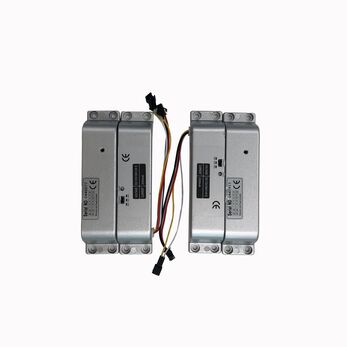
In many applications, the interlock controller only needs to block the door opening signal. When the opposite door is open, the automatic door controller does not receive an activation command.
However, an electromagnetic lock may be added in areas requiring stricter security, pressure control, or access control. In such cases, the selected lock should provide suitable holding force and a safe emergency-release mechanism.
Any additional electrical lock must be compatible with the automatic door controller, anti-pinch sensors, and the building’s emergency-egress requirements.
Automatic door interlock control methods
Dedicated interlock controller
A dedicated interlock controller is suitable for systems involving two or three doors with relatively simple operating logic.
This solution offers reasonable cost, straightforward installation, simple maintenance, and no requirement for complex programming. It is commonly used in buffer rooms, airlocks, and two-door controlled areas.
PLC control
A PLC is more suitable for systems with multiple doors or complex operating requirements.
In addition to preventing simultaneous door opening, the PLC can process conditions such as pressure differential, delay time, user access authorization, fire alarm signals, sensor faults, and BMS communication.
A PLC is also more suitable where an HMI, operating-status records, alarm history, or future expansion is required.
Built-in interlock function of the automatic door controller
Some automatic door controllers include a built-in airlock or interlock mode. Two door controllers can exchange signals directly without requiring a separate interlock controller.
This solution should only be used when the door manufacturer confirms compatibility and provides complete wiring diagrams, operating logic, and fault-handling instructions.
Is an automatic door interlock suitable for cleanrooms?
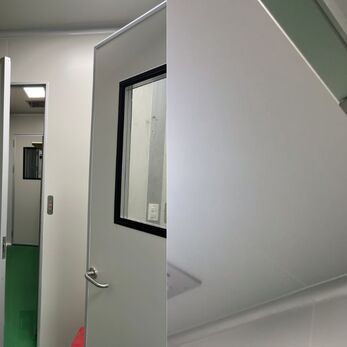
An automatic door interlock is highly suitable for cleanrooms because it reduces hand contact while controlling the door opening and closing sequence.
In a cleanroom, simultaneous opening of two doors between areas with different cleanliness classifications or pressure levels can change the airflow direction. Air from a less clean area may enter a cleaner area, increasing the risk of particle or microbiological contamination.
Interlock systems are therefore commonly installed in:
-
Personnel airlocks.
-
Material airlocks.
-
Buffer rooms.
-
Changing rooms.
-
Pharmaceutical production areas.
-
Operating rooms and medical facilities.
-
Electronics and semiconductor factories.
-
Laboratories and biological containment areas.
Important considerations when designing an automatic door interlock
The interlock system must confirm that one door has fully closed before allowing the other door to open. Door position sensors should be installed correctly and protected against false signals caused by vibration or mechanical misalignment.
Anti-pinch sensors and obstruction-detection functions must not be disabled by the interlock logic. Personnel safety must always take priority over pressure differential or contamination-control requirements.
The design should also clearly define door behavior in the following situations:
-
Power failure.
-
Fire alarm activation.
-
Sensor failure.
-
Door closing timeout.
-
Obstruction in the doorway.
-
Emergency release activation.
For GMP projects, interlock logic should be verified during FAT, SAT, IQ, and OQ. The test scope should include cross-locking functions, door-open timeout alarms, power failure behavior, emergency release, and door status feedback.
Can an interlock system control three or more automatic doors?
Yes. An interlock system can control two, three, four, or more automatic doors.
For multi-door systems, a PLC is often more suitable because it can establish door groups and support different operating conditions.
For example, in a three-door airlock, the system may allow only one door to open at a time. In a larger installation, some doors within the same pressure zone may be permitted to operate simultaneously, while doors connecting to cleaner areas remain locked.
The control logic should be developed based on personnel flow, material flow, cleanliness classification, and actual pressure differential requirements.
Where should you buy an automatic door interlock system?
When purchasing an interlock system for automatic doors, businesses should not evaluate the product based only on the controller price. Compatibility with the automatic door system, number of doors, sensor type, emergency-release method, and integration requirements for PLC or BMS should also be considered.
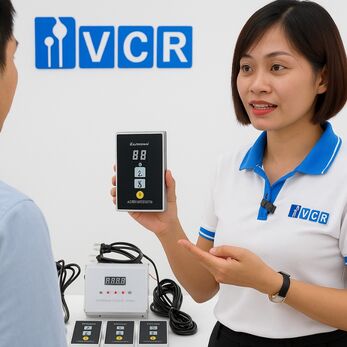
Vietnam Cleanroom Equipment supplies interlock solutions for cleanroom doors, automatic doors, airlocks, Pass Boxes, and contamination-controlled areas. The company can support cleanroom contractors, investors, and factory operators in selecting an appropriate configuration based on the number of doors, operating logic, and project requirements.
When requesting a quotation, customers should provide the following information:
-
Number of doors to be interlocked.
-
Manual or automatic door type.
-
Brand and model of the automatic door controller.
-
Available input and output signals.
-
Requirements for indicator lights, alarms, and emergency buttons.
-
Requirements for PLC, HMI, or BMS integration.
-
Standards and technical requirements applicable to the project.
Providing complete information allows Vietnam Cleanroom Equipment to recommend the correct configuration, reduce installation risks, and ensure stable system operation.
Criteria for selecting an automatic door interlock supplier
An interlock supplier should understand electrical equipment, automatic door control, and cleanroom operating requirements.
An interlock controller may work correctly during standalone testing but still fail after installation if the signals between the automatic door controller and interlock controller are incompatible.
Customers should therefore prioritize suppliers that can:
-
Check the signal diagram of the automatic door controller.
-
Develop interlock logic based on actual personnel and material flow.
-
Provide clear wiring diagrams.
-
Support installation and commissioning.
-
Verify emergency-release functions.
-
Provide responsive after-sales technical support.
-
Support system expansion when the number of doors increases.
Vietnam Cleanroom Equipment can be considered when businesses need interlock controllers, cleanroom door accessories, or door interlocking solutions for pharmaceutical, electronics, food-processing, hospital, and laboratory projects.
Conclusion
An interlock system can be used effectively with automatic doors. It prevents two doors from opening at the same time, maintains pressure differentials, controls airflow direction, and reduces the risk of cross-contamination.
For stable operation, the automatic door must provide compatible control signals, a reliable door-closed confirmation sensor, and appropriate safety logic for power failure, fire alarm activation, or sensor malfunction.
For cleanroom projects, customers should select a supplier capable of supporting equipment selection, wiring, control logic, commissioning, and troubleshooting. Businesses requiring an interlock system for automatic doors can contact Vietnam Cleanroom Equipment for technical consultation and configuration recommendations based on the number of doors and project requirements.
FAQ: Frequently Asked Questions About Automatic Door Interlock Systems
Does the interlock system directly control the automatic door motor?
Normally, the interlock system does not directly control the door motor. It sends or interrupts the opening permission signal to the automatic door controller. The automatic door controller remains responsible for motor operation, movement speed, and safety sensor processing. Vietnam Cleanroom Equipment can help check the door controller terminals and recommend a compatible connection method.
Can an automatic door with a motion sensor be integrated with an interlock system?
Yes. The signal from the motion sensor can be routed through the interlock controller or connected to the opening permission input of the automatic door controller. When the opposite door is open, the interlock blocks the activation signal. Vietnam Cleanroom Equipment can recommend motion sensors, touchless sensors, push buttons, or card readers based on the access-control requirements of the area.
Does an automatic door interlock require an electromagnetic lock?
Not necessarily. If the automatic door controller can block the opening command, the interlock system may only need to disable the control signal. An electromagnetic lock is usually added when stronger door retention or access security is required. Vietnam Cleanroom Equipment can assist in selecting the lock type, holding force, and emergency-release configuration.
What happens to an automatic door interlock during a power failure?
Door behavior during a power failure depends on the safety design of the facility. The door may become freely openable, remain locked with backup power, or switch to manual operation. Vietnam Cleanroom Equipment recommends defining emergency-egress requirements, fire alarm logic, and fail-safe or fail-secure behavior before selecting the system.
Can an interlock system be connected to a fire alarm system?
Yes. The interlock controller can receive a fire alarm signal to release the doors or switch the system into emergency mode. The exact operating logic depends on the building’s emergency-egress design. Vietnam Cleanroom Equipment can support the determination of fire alarm inputs and appropriate emergency operating modes.
Can an automatic door interlock be connected to a BMS?
Yes. If the interlock controller or PLC has suitable outputs or communication interfaces, it can send door status, fault alarms, and door-open timeout signals to the BMS. Vietnam Cleanroom Equipment can recommend appropriate input, output, or communication configurations for the project.
Can one interlock controller operate several automatic doors?
Yes, but the maximum number of doors depends on the controller capacity. A dedicated interlock controller may be used for two or three doors. For larger systems or complex operating logic, a PLC is usually recommended. Vietnam Cleanroom Equipment can help select the controller and develop operating logic based on the number of doors.
What factors affect the price of an automatic door interlock system?
The price depends on the number of doors, lock type, sensors, indicator lights, alarms, emergency buttons, PLC, HMI, and BMS integration requirements. Costs also vary depending on the complexity of connecting the interlock controller to the automatic door system. Customers should provide the door controller specifications to Vietnam Cleanroom Equipment to receive an appropriate technical proposal and quotation.
Contact Vietnam Cleanroom Equipment
Customers looking for interlock systems for automatic doors, cleanroom doors, airlocks, or Pass Boxes can contact:
VIETNAM CLEANROOM EQUIPMENT
Hotline: 090.123.9008
Email: [email protected]
Website: vietnamcleanroom.com
Vietnam Cleanroom Equipment provides configuration consultation, accessory selection, signal compatibility checks, and interlock solutions tailored to each cleanroom project.